Employee Background Screening: Why Smarter Hiring Starts Before Day One
Trust is not a strategy. It is what you fall back on when you have no better option.
In a world where credential fraud is rising, professional histories are routinely embellished, and identity misrepresentation has never been easier to execute, extending trust without verification is not open-mindedness it is exposure. The cost of misplaced trust is rarely abstract. It shows up in financial losses, regulatory penalties, safeguarding failures, and reputations that take years to rebuild.
Employee background screening exists because evidence is always more reliable than assumption.
Contents
Employee Background Screening: Why Smarter Hiring Starts Before Day One. 1
What Is Employee Background Screening?. 1
Why Background Screening Matters More Than Ever. 2
What Does a Background Screening Check Include?. 3
DBS Checks and Criminal Record Checks for Employers. 4
What Fails a Background Check?. 4
The Risks Employers Often Miss. 5
How DE RISC GROUP Supports Smarter Hiring. 6
Building a Smarter Background Screening Process. 6
Modern organizations can no longer afford to make consequential hiring decisions on the basis of interviews and self-reported information alone. The professional landscape has shifted remote recruitment has gone global, onboarding has moved online, and the volume and sophistication of fraudulent applications has grown in step with every new digital convenience. At the same time, regulatory expectations around due diligence, safeguarding, and data security have tightened considerably. In this environment, verifying who you hire is not merely good practice it is a strategic imperative.
Employee background screening is, at its core, the process of replacing assumption with evidence. It confirms identity, validates employment history, verifies qualifications, and where the role demands it discloses criminal record information that could be material to a hiring decision. Done well, it does not create unnecessary barriers for candidates. It creates a foundation of verified truth on which sound, fair, and legally defensible hiring decisions can be made.
As the pace of recruitment continues to accelerate in 2026, the organizations that will build the most resilient, trustworthy, and high-performing teams are those that invest in screening not as a compliance afterthought, but as a core pillar of their hiring strategy starting long before day one.
What Is Employee Background Screening?
Employee background screening is the structured process of independently verifying the information a candidate provides during recruitment before employment begins.
Its purpose is straightforward, to confirm that the individual is genuinely who they claim to be, that the professional details presented throughout the hiring process are accurate, and that no material risks have been overlooked or concealed. Depending on the role, the industry, and the level of risk involved, the scope of screening can range from basic identity verification to a comprehensive review spanning employment history, educational qualifications, criminal records, professional references, right-to-work status, and international checks.
Crucially, background screening gives employers an independent, evidence-based view of a candidate that interviews simply cannot provide. It is not a reflection of distrust it is a reflection of professionalism, diligence, and sound risk management.
For regulated industries such as healthcare, finance, education, legal services, and insurance, formal background checks are frequently a legal requirement. But the shift toward structured screening is now happening across every sector, driven by growing awareness that hiring risk is universal and that a single oversight can have consequences that extend far beyond the recruitment process itself.
Why Background Screening Matters More Than Ever
The way companies hire has changed dramatically. At the same time the risks that come with hiring have changed even more.
Remote recruitment has opened access to an unprecedented global talent pool but it has also made candidate verification significantly harder. Employers are no longer meeting applicants face-to-face before making offers. Onboarding happens entirely online. Work histories are increasingly international, fragmented, and difficult to validate without structured processes in place.
Against this backdrop, the scale of recruitment fraud has grown in ways many employers are only beginning to appreciate. Falsified job titles, fabricated degree certificates, manipulated employment dates, fake references, and identity inconsistencies are identified regularly during professional screening across all sectors and seniority levels, not just regulated industries.
The consequences of a poor hiring decision extend well beyond a difficult performance conversation. Depending on the role and the nature of the issue, they can include financial losses, regulatory penalties, data security breaches, safeguarding failures, reputational damage, and significant operational disruption. In some cases, the liability extends to third party clients, customers, or vulnerable individuals who trusted the organization to exercise appropriate care.
It is also important to note that not every discrepancy identified during screening is the result of deliberate fraud. Outdated information, honest mistakes, and misunderstood timelines do occur. But employers still need reliable processes that allow them to distinguish between innocent inaccuracies and material concerns, and to make those determinations before the employment relationship begins.
The purpose of screening is not to assume the worst of candidates. It is to ensure that every hiring decision is grounded in verified facts rather than unchallenged assumptions.
What Does a Background Screening Check Include?
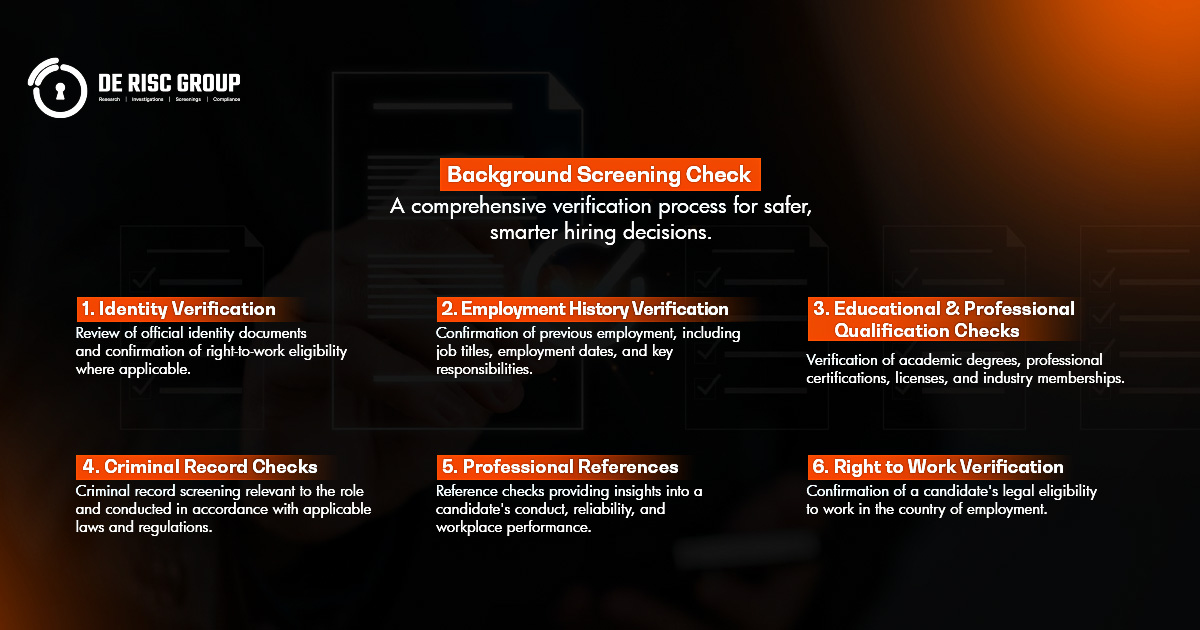
One of the most common questions from employers is straightforward: what does a background screening check actually cover?
The answer depends on the nature of the role and the level of risk it carries. A junior administrative position and a senior role involving access to financial data, vulnerable individuals, or confidential systems will not, and should not, require identical scrutiny. However, most structured screening programs draw from several core verification stages.
Identity Verification is typically the starting point. This involves reviewing official identity documents including passports, national identity cards, driving licenses, visas and confirming right-to-work eligibility where applicable. With remote hiring now commonplace, identity verification has become especially critical. Organizations that never physically meet a candidate before employment begins are particularly exposed to identity fraud risks that a structured verification process is designed to catch.
Employment History Verification involves independently confirming previous roles, employment dates, job titles, and professional responsibilities directly with verified sources rather than accepting candidate-provided information at face value. This stage consistently reveals one of the most common categories of misrepresentation: inflated responsibilities, altered employment dates, hidden gaps, and job titles that bear only a passing resemblance to the candidate's actual role. For employers, the gap between what was claimed and what can be verified is often the most revealing part of the process.
Educational and Professional Qualification Checks verify that the academic degrees, certifications, professional licenses, and industry memberships a candidate cites are genuine. This is particularly important in regulated or specialist roles where specific qualifications are not merely desirable but legally required.
Criminal Record Checks are conducted where the nature of the role including safeguarding, trust, financial responsibility, or access to sensitive systems, makes disclosure relevant. The scope and legal framework for these checks varies by jurisdiction and role type.
Professional References provide additional qualitative context around conduct, reliability, and workplace performance particularly valuable when reviewed as part of a broader screening picture rather than in isolation.
Together, these checks provide something no interview alone can: a verified, independent, multi-dimensional view of a candidate before they step through the door.
DBS Checks and Criminal Record Checks for Employers
In the United Kingdom, the most widely recognized form of criminal record screening is the DBS check conducted through the Disclosure and Barring Service, the official body responsible for processing criminal record disclosures in the UK.
DBS checks exist at several levels, each calibrated to the nature of the role being filled. A Basic DBS check discloses unspent convictions and is appropriate for a broad range of general employment purposes. A Standard DBS check provides a wider level of disclosure, covering both spent and unspent convictions, cautions, reprimands, and warnings. An Enhanced DBS check goes further still, and may include additional information held by local police forces, along with a check against the relevant barred lists where the role involves regulated activity with children or vulnerable adults.
It is essential for employers to understand that different roles qualify for different levels of check and that requesting a level of disclosure that exceeds legal entitlement is not simply unnecessary, it is unlawful. Professional screening providers ensure that the checks requested are appropriate, proportionate, and fully compliant with the relevant legal framework.
It is equally important to understand what a DBS check is not. A clear criminal record does not eliminate all hiring risk, just as a disclosed criminal history does not automatically disqualify a candidate. Responsible screening means evaluating findings in context assessing relevance, recency, and proportionality rather than applying blanket exclusion policies that are likely to be both unfair and legally problematic.
A DBS check is one important layer within a broader screening process. It should always be used alongside not instead of other verification measures.
What Fails a Background Check?
There is rarely a single, universal answer to what fails a background check. Outcomes depend on the role, the employer's policies, the legal requirements of the industry, and critically the nature and relevance of whatever has been identified.
What can be said with confidence is this: in many cases, the concern is not the finding itself, but the dishonesty that preceded it.
In many cases, what ultimately raises concern during a background check is not simply the existence of a past issue, but the dishonesty that preceded it. Professional screening most commonly uncovers problems such as exaggerated responsibilities, altered employment dates, fabricated job titles, or the concealment of significant employment gaps within a candidate’s work history. Employers also frequently encounter unverifiable or fraudulent qualifications, including fabricated degrees, falsified certifications, or claimed memberships with professional bodies that cannot be validated. In some situations, identity inconsistencies emerge through discrepancies in official documents, names, or personal details, potentially indicating identity misrepresentation. Failed right-to-work verification is another serious issue, particularly where a candidate does not hold the legal authorization required to work within the relevant jurisdiction. Screening may also reveal undisclosed criminal records that are directly relevant to the responsibilities of the role, alongside significantly adverse professional references that raise material concerns regarding conduct, reliability, integrity, or overall suitability for employment.
Modern, professional screening practices are increasingly centered on context and proportionality rather than automatic rejection. The goal is informed decision-making, understanding what was found, what it means in the context of the specific role, and what a fair, defensible response looks like.
The Risks Employers Often Miss
One of the most persistent misconceptions about background screening is that a single check provides a complete picture of risk. It does not.
Every screening method has inherent limitations. A criminal record check reflects only officially recorded information it cannot surface concerns that have never been formally documented. Employment verification confirms stated work history but does not automatically reveal the reasons behind departures or the nature of workplace conduct. References provide additional context, but only when they are properly structured, independently verified, and assessed as part of a wider picture.
This is why leading organizations have moved toward layered screening models combining multiple checks that each addresses a different dimension of hiring risk, so that gaps in one area are offset by coverage in another.
Hiring risk rarely presents itself neatly in one category. It commonly cuts across identity, professional history, conduct, regulatory compliance, safeguarding, and financial trust often simultaneously. An employer who checks criminal records but skips employment verification may miss the candidate who has a clear record but an entirely fabricated career history. An employer who verifies employment but skips identity checks may not discover that the person being hired is not who they claim to be at all.
A smarter hiring process recognizes the interconnected nature of these risks and builds verification that is broad enough, and deep enough, to address them properly.
How DE RISC GROUP Supports Smarter Hiring
At DE RISC GROUP, background screening is understood as something more than a compliance checkbox. It is a structured, intelligence-driven process designed to help organizations make genuinely informed hiring decisions consistently, accurately, and in full alignment with their legal obligations.
The process begins with a careful assessment of the role itself: the level of trust it carries, the access it grants, the regulatory environment it operates in, and the specific risks it presents. There is no one-size-fits-all approach. Different positions require different scopes of verification, and a professional screening partner should be capable of tailoring that scope accordingly.
Once requirements are established, candidates are guided through a secure, streamlined submission process. From there, DE RISC GROUP conducts the relevant checks which may include identity verification, employment history validation, DBS and criminal record screening, qualification checks, right-to-work confirmation, professional reference review, and international screening where candidates have lived or worked abroad. All verification is conducted directly through trusted, authorized sources to ensure accuracy and compliance throughout.
The outcome is not simply a report it is a clear, structured, and actionable assessment that gives hiring teams the verified foundation they need to make confident decisions. By combining technology-driven verification systems with expert human oversight and rigorous compliance standards, DE RISC GROUP helps organizations reduce hiring risk without compromising the speed and professionalism of the candidate experience.
In an era of increasingly global, digital, and high-velocity recruitment, the ability to deliver both speed and accuracy without sacrificing compliance is not a nice-to-have. It is the standard.
Building a Smarter Background Screening Process
An effective background screening process is not an administrative afterthought. It is a strategic component of responsible hiring, one that should be integrated from the earliest stages of recruitment, not bolted on at the end.
The strongest screening processes share a set of common characteristics. They define screening requirements clearly and in advance, matched to the risk profile of each role. They obtain proper, informed candidate consent in line with data protection regulations. They apply checks consistently across all similar roles to avoid discrimination claims or selective enforcement. And they ensure that all processes comply with the relevant employment law, right-to-work legislation, and data handling obligations.
Increasingly, employers are also recognizing that the screening obligation does not always end at onboarding. For roles carrying long-term trust, regulatory responsibility, or ongoing access to sensitive data or vulnerable individuals, periodic re-screening and ongoing monitoring are becoming standard practice. The risk profile of an individual can change over time and an organization’s due diligence should reflect that.
The hiring landscape will continue to evolve. Organizations that build screening processes that are structured, scalable, and adaptable will be significantly better positioned to manage the risks that come with it and to build teams that are not just capable, but genuinely trustworthy.
FAQs
Q1: What is employee background screening?
Employee background screening is the structured process of independently verifying a candidate's identity, employment history, qualifications, criminal record, and other relevant information before a hiring decision is finalized.
Q2: What does a background screening check include?
Depending on the role, it can include identity verification, right-to-work checks, employment history validation, educational and professional qualification checks, criminal record and DBS checks, professional references, and international screening.
Q3: What is a DBS check?
A DBS (Disclosure and Barring Service) check is a UK criminal record screening process used to support safer hiring decisions. Different levels of DBS apply to different types of roles and carry different scopes of disclosure.
Q4: What fails a background check?
Common concerns include false or misleading employment history, fabricated qualifications, identity inconsistencies, failed right-to-work verification, undisclosed criminal records relevant to the role, and significantly adverse professional references.
Q5: Why is employment history verification important?
Because self-reported work history is one of the most commonly misrepresented elements of a job application. Verification confirms whether a candidate's claimed experience is genuine, accurate, and actually relevant to the role being filled.
Q6: Can employers conduct international background checks?
Yes. Professional screening providers are equipped to conduct international verification for candidates who have lived or worked in multiple countries, including employment history checks, criminal record screening, and qualification validation across different jurisdictions.
Q7: Is background screening the same for every role?
No and it should not be. The scope of screening should be proportionate to the risk profile of the specific role. A one-size-fits-all approach is neither efficient nor legally sound.
Final Thoughts
Effective hiring begins with verified information, not assumptions. A comprehensive background screening process helps organizations reduce hiring risks, strengthen compliance, and build a workforce founded on trust and integrity. By investing in thorough, role-specific screening, employers can make confident hiring decisions that protect their people, reputation, and long-term success. Partnering with an experienced screening provider like DE RISC GROUP ensures a seamless, compliant, and reliable verification process—helping you hire with confidence from day one.